
How to Score 15+ in Super TET Math Using UP SCERT 6 to 8 (Even If You Hate Math)

How to Score 15+ in Super TET Math Using UP SCERT 6 to 8 (Even If You Hate Math)

There’s no doubt in my mind that this will be the most practical Super TET Math strategy you’ll come across if you’re scared of numbers.

I’m going to show you how to use only UP SCERT Class 6 to 8 maths to reach 15+ marks out of 20 in Super TET Math — even if:

  • you come from an Arts / Humanities background,
  • you “hate” math or froze in every school exam,
  • you are preparing alongside a job or D.El.Ed, not as a full‑time student.

Over the last 20 years, I’ve seen one pattern again and again. Candidates who treat Super TET Math as “high‑level competitive maths” burn out quickly. Those who treat it as smartly repeated school‑math quietly slide past 15+ or even full marks. The exam syllabus, previous paper analysis, and topic‑wise strategies all confirm a vital reality. Super TET Math questions are anchored strictly in basic school concepts — number system, arithmetic, mensuration, geometry, and data handling.

In my main Super TET strategy guide, Super TET 120+ Score Blueprint , I show you the full exam map. Here, I’m going to hand you the pure math playbook. If you are a working aspirant, you can plug this directly into the Super TET Working Professional Study Routine and turn small daily pockets into steady math marks.


First, the reality check: what Super TET Math really tests

Before you touch a single chapter, you need to understand what the exam is actually asking from you. Super TET Math is not a research exam. It is a school‑math competency test aligned with the UP school curriculum and teaching requirements.

Look at any recent Super TET / UPTET math discussion:

  • Coaching breakdowns and course pages clearly show topics like Number System, Fractions, Decimals, Ratio–Proportion, Percentage, Profit & Loss, Simple/Compound Interest, Time & Work, Geometry, Mensuration, and Data Handling as the absolute backbone of the paper.
  • Many “how to score full marks in TET Maths” videos don’t start with advanced tricks. They start with repeat questions from these exact same school‑level chapters.

What does this mean for you? Two things:

  • You don’t need college‑level math skills.
  • You do need clean control over the important Class 6–8 concepts.

Once you accept this, math stops being a monster. It becomes a transparent list of chapters you can systematically conquer.


Visualizing the High-Yield Math Marks Breakdown

To hit 15+ marks efficiently, you should not give equal weight to every single topic. You must prioritize the core arithmetic clusters that carry the highest ROI.
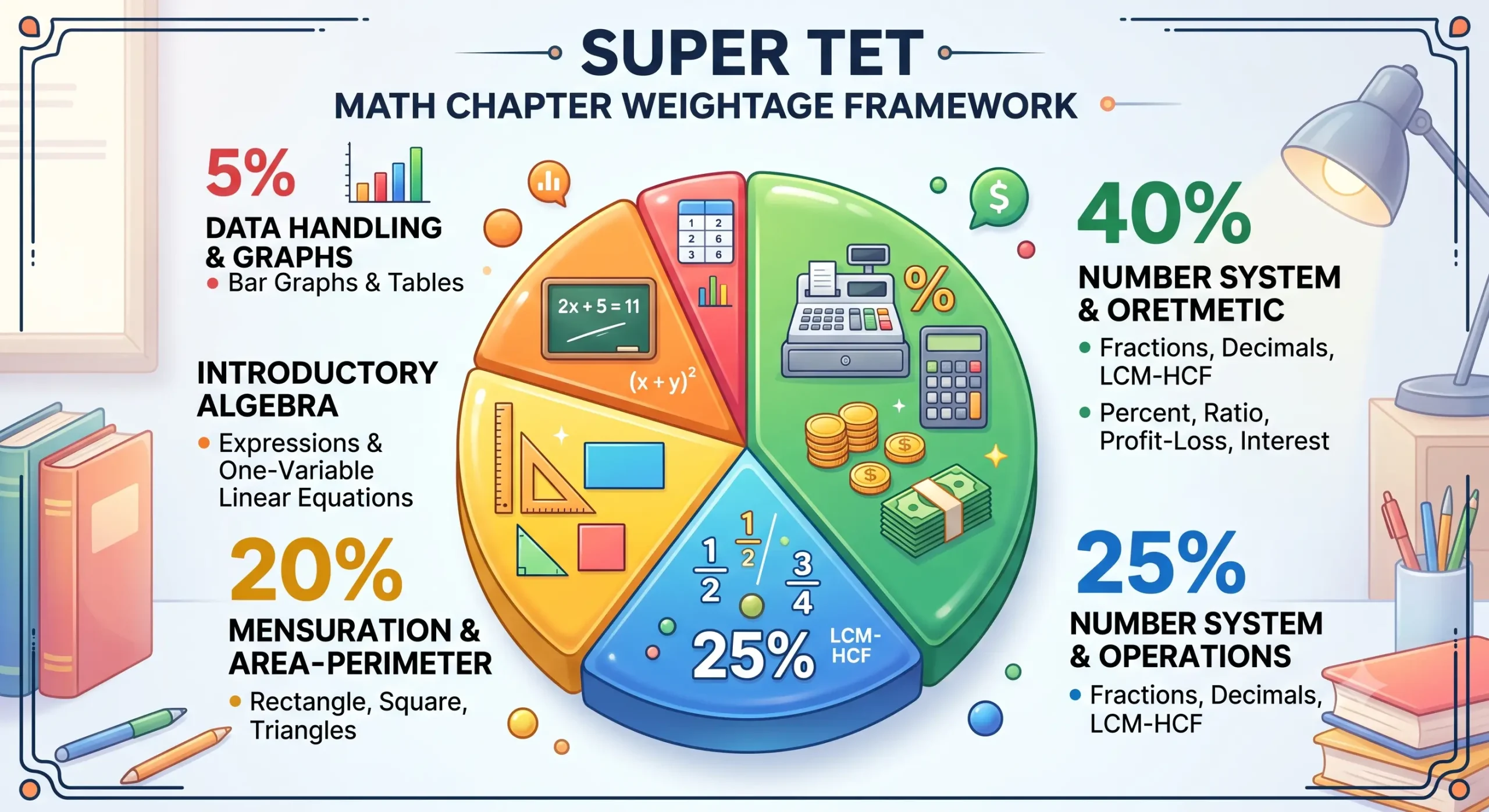
Super TET Math Chapter Weightage Framework Pie Chart breaking down commercial arithmetic, number system, mensuration, algebra, and data handling.

The strategic chapter weightage breakdown to help you secure 15+ marks in Super TET Math efficiently.


The 15+ marks mindset (especially if you hate math)

Most non‑math aspirants make one of two classic mistakes:

  • They avoid math till the last month, hoping to “manage somehow” in the exam.
  • They over‑react and buy heavy competitive books that are far more complex than the actual question level.

Your goal is much simpler. Secure 15 safe marks first, then stretch towards 18–20 with practice and smart guessing. You will do this by:

  • Choosing the right UP SCERT 6–8 chapters instead of blindly studying everything.
  • Practising 10–15 questions daily instead of weekend 5‑hour “guilt sessions”.
  • Leveraging the no negative marking rule to attempt the final tricky questions without fear.

If you stay with me till the end of this guide, you’ll have a complete chapter checklist and a daily/weekly plan. Real aspirants can actually follow this, even with a full‑time job or D.El.Ed schedule.


The exact UP SCERT 6–8 chapter checklist that matters

Let’s start with the core of this strategy: which chapters to study. Super TET Math draws heavily from the state board / SCERT content structure. This means focus remains on basic arithmetic, elementary algebra, simple geometry, mensuration, and introductory data handling.

A. Number System & Operations (non‑negotiable)

If your basics are weak here, everything else feels painful. So we fix this first.

  • Natural numbers, whole numbers, and integers.
  • Place value, face value, large numbers reading and writing.
  • Fractions: like/unlike, proper/improper, and mixed fractions.
  • Decimals: place values, operations, and decimal–fraction conversions.
  • LCM and HCF of numbers.
  • Squares and square roots, cubes and cube roots (concept + simple calculation).

These are the specific chapters that show up again and again in TET‑level papers across states. They are explicitly part of the formal math syllabus for teacher eligibility exams.

B. Everyday Arithmetic (your highest ROI cluster)

This is where a big chunk of your 15+ score actually comes from.

  • Ratio and proportion.
  • Percentage and its applications (increase/decrease, comparison, scores, attendance, etc.).
  • Profit, loss, and discount.
  • Simple interest and basic compound interest.
  • Unitary method and direct–inverse variation ideas.

TET math strategy videos and courses across languages keep repeating the same advice. Master percent, profit, loss, SI/CI, and ratio. They contribute a massive share of questions and are built directly on Class 6–8 arithmetic.

C. Introductory Algebra (only the useful parts)

  • Basic algebraic expressions and identities.
  • Simple linear equations in one variable.
  • Simple factorisation and expansion (only up to what is seen in Class 7–8).

Super TET doesn’t expect you to solve long, complex algebra. It expects you to be comfortable with the basic algebra that appears in middle school.

D. Geometry & Mensuration (score booster, not optional)

  • Lines and angles, including basic types of angles.
  • Triangles: types, basic properties, and the angle sum property.
  • Quadrilaterals: rectangle, square, parallelogram, and rhombus basics.
  • Circle basics: radius, diameter, and circumference ideas at a formula level only.
  • Perimeter and area of rectangle, square, triangle, and parallelogram.
  • Surface area and volume of cube and cuboid. Ensure introductory coverage of cone, cylinder, and sphere according to syllabus depth.

Many Super TET and UPTET math analysis classes show that area–perimeter and mensuration questions are regular features, drawn directly from these exact shapes.

E. Data Handling & Graphs (often ignored, still important)

  • Reading and interpreting bar graphs.
  • Simple pie‑charts and line graphs from SCERT classes 7–8.
  • Frequency tables, tally marks, and basic averages.

Teacher‑exam syllabi explicitly mention data interpretation and graphical representation as core abilities. These skills are later used directly in classroom evaluation and reporting.

F. Priority table: where your 15+ marks really come from

Chapter Cluster Priority for 15+ marks Why it matters
Number system, fractions, decimals Very High Used inside almost every other chapter. Foundational for daily calculations.
Percent, ratio, profit–loss, SI/CI Very High Huge share of typical TET math questions. This is the core of commercial math.
Mensuration & area–perimeter High Regular question source. Purely formula‑based but easy once memorised and practised.
Basic algebra (equations, expressions) Medium Appears in a few questions. Can be easily mastered with limited syllabus depth.
Data handling & graphs Medium Often yields 1–2 straightforward questions if covered. Quick, easy marks.

What to study first if you absolutely hate math

If your math fear is high, starting in the wrong order will kill your momentum. Don’t open the toughest mensuration or algebra problems on day one. Start with chapters that give you quick wins.

Recommended starting order:

  1. Fractions and decimals – because they appear inside every other chapter.
  2. Percentages – then directly connect this to profit–loss and simple interest.
  3. Ratio and proportion – then unify with percentage layouts for complex question types.
  4. Profit & Loss, Simple Interest – socially familiar situations that are easier to visualise.
  5. Perimeter and area of rectangle/square/triangle – simple formulas that are highly scoring.

Only after this first wave should you move to square roots, advanced mensuration shapes, or algebra identities. Aspirants repeatedly state that their confidence changed when they began with percentage, P&L, and SI. Seeing yourself get full marks in those sections shifts your entire mindset.


The “10–15 Question” rule (your daily engine for 15+)

One thing I’ve learned from studying real aspirant vlogs and exam comment sections is clear. The toppers who came from non‑math backgrounds rarely studied math for 4–5 hours a day. Instead, they:

  • picked a small, targeted set of chapters,
  • solved 10–15 questions daily from those specific topics,
  • and repeated that consistency for weeks, not days.

So here is the golden rule for you:

Every single day until the exam, solve 10–15 questions from UP SCERT back‑of‑chapter exercises or aligned practice sets — no matter what.

Not “someday on Sunday”. Every single day.

You can plug this directly into your pocket‑study routine:

  • Use your evening deep pocket (45–60 minutes) for these 10–15 math questions.
  • Use your morning or night pocket to revise formulas and update your error notebook.

A simple weekly framework to reach 15+ marks

Let’s convert all this into something you can actually follow. Think in weeks, not random scattered days.

Week structure for non‑math aspirants

  • 3 “core” days – focus purely on arithmetic (percent, ratio, P&L, SI).
  • 2 “support” days – number system + fractions and decimals.
  • 1 “shape” day – mensuration and area–perimeter formulas.
  • 1 “mix” day – handling a mini test, your error notebook, and light algebra.

Each study day, you have just two tasks:

  1. Revise 5–10 formulas or core ideas from that day’s specific topic.
  2. Solve 10–15 questions from the SCERT exercises or equivalent level practice sets.

Example for one week:

  • Day 1 (Mon): Fractions & decimals – focus on conversions, basic operations, and comparison.
  • Day 2 (Tue): Percentage basics – solve “x% of y” formatting and increase/decrease trends.
  • Day 3 (Wed): Ratio & proportion – master simple ratios, equivalent ratios, and basic word problems.
  • Day 4 (Thu): Profit & Loss – focus heavily on cost price, selling price, and gain/loss %.
  • Day 5 (Fri): Simple Interest – clean formula usage tracking time, rate, and principal problems.
  • Day 6 (Sat): Area–perimeter – focus on rectangle, square, and triangle properties.
  • Day 7 (Sun): Execute a mini test (20–25 questions) paired with a detailed analysis of mistakes.

This one‑week pattern directly feeds your 15+ score goal. It continuously cycles through the highest‑yield topics instead of scattering your attention.


The 21‑day “zero‑to‑steady” Super TET Math plan

If you give yourself just three focused weeks, here’s how I’d structure it for an aspirant who hates math.

Week 1 – Stabilise your basics

  • Fractions: master types and operations using practice sets from Class 6–7 exercises.
  • Decimals: control place values, the four operations, and fractions conversions.
  • Number system warm‑up: process natural/whole/integers alongside basic LCM/HCF.
  • Daily task: 10–15 targeted questions paired with a 5–10 minute formula recap.

Week 2 – Attack the scoring cluster

  • Percentages: clear the basics, then focus on increase/decrease and comparison values.
  • Ratio & proportion: solve real‑life style word problems.
  • Profit & Loss: dominate CP, SP, and discount concepts.
  • Simple Interest: execute direct formula questions without over‑complicating them.
  • End of week: Solve a 25–30 question mixed test combining these four topics.

Week 3 – Mensuration + consolidation

  • Area & perimeter: rectangle, square, and triangle formulas are absolute must‑knows.
  • Basic mensuration: solve practical word problems involving tiles, flooring, and fencing.
  • Intro algebra: handle one‑variable linear equations within simple contexts.
  • Data handling: clear 1–2 sets of straightforward bar graph or table questions.
  • End of week: Complete 1 full Super TET‑level math section mock (20 questions) and update your error notebook.

After these 21 days, you’re no longer someone who “hates math”. You are someone who has repeated the core Super TET math environment often enough that 15+ becomes a realistic, data‑backed target.


How UP SCERT chapters translate into actual Super TET questions

Let’s connect the dots. How does a simple Class 7 or 8 chapter become an actual exam question?

  • UP SCERT Percentage chapter → Translates directly to Super TET questions on exam scores, attendance percentages, discounts, and population changes.
  • UP SCERT Ratio & proportion → Appears as mixture questions, distribution of money, or class strength ratios.
  • UP SCERT Perimeter and area → Converts into fencing a field, flooring a room, or planting trees along a boundary.
  • UP SCERT Data handling → Turns into reading bar graphs of class marks or interpreting student attendance charts.

Edu‑prep platforms that specialise in Super TET clearly state a consistent fact. The math section is aligned with state syllabus topics for Classes 1–5 and 6–8. This is why solving SCERT‑style questions is often completely enough to match the difficulty level of real papers.


The “no negative marking” advantage (your secret weapon)

One massive strategic advantage in Super TET is that there is no negative marking. This is reflected in the standard patterns shared across official syllabus guidelines. For someone who fears math, this is golden.

Here’s exactly how to exploit it:

  1. Use your UP SCERT‑based preparation to identify and solve the 10–12 easy questions you are confident about. These live primarily within percentage, ratio, P&L, SI, and basic area–perimeter.
  2. Then push hard to solve the next 3–5 medium questions where you can track structural steps, even if it takes more time.
  3. For the remaining hardest questions, use option elimination and approximation instead of leaving items completely blank. Even a minor success rate here lifts your total score.

When I say “15+”, I’m not imagining that you will solve every single question elegantly. I’m imagining a clear framework where you:

  • secure 12–14 marks from mastered SCERT chapters, and
  • collect 1–4 extra marks from educated guesses on tougher items.

That is exactly how many non‑math candidates pass TET‑type exams every year. It matches the real success stories shared across elite preparation channels.


Common mistakes that kill math scores (especially for Arts background)

The same strategic errors appear again and again across exam‑prep discussions:

  • Memorising formulas without actual practice – People write formulas 10 times but never solve real questions. They freeze in the exam when the word context changes slightly.
  • Jumping directly into “shortcuts” – Tricks are useful only after you understand the basic concept. Using them too early makes math more confusing.
  • Ignoring fractions and decimals – They feel “too basic”, so aspirants skip them. They then struggle in every other chapter which quietly depends on calculation basics.
  • Over‑relying on coaching PDFs – Many PDFs are designed as quick revision tools for already‑strong students, not as learning tracks for scared learners.
  • Starting math prep too late – People spend months on theory subjects and push math to the final 30 days. Math needs slow, low‑stress daily repetition instead of last-minute cramming.

If you avoid just these mistakes, you are instantly ahead of a big chunk of the competition.


How to integrate this strategy with your full Super TET plan

This article is your math engine. To win the full exam, you need to plug it directly into a complete Super TET strategy layout. That’s where the two other pieces come in:

  • For the overall 120+ strategy: The Super TET 120+ Score Blueprint
    shows you exactly how math sits alongside languages, pedagogy, and Life Skills in a forensic way.
  • For time‑crunched aspirants: The Super TET Working Professional Study Routine
    gives you a pocket‑based routine (morning, commute, evening, night). You can use this to easily schedule your 10–15 daily math questions.

Together, these three pieces — blueprint, routine, and this SCERT‑math strategy — create a complete, intent‑driven path. They take you from “I hate math” to “I know exactly how to secure my 15+ marks.”


Quick FAQ: Super TET Math using UP SCERT 6–8

1. Can a non‑math, Arts background candidate really score 15+ in Super TET Math?

Yes. They absolutely can. Coaching analysis and exam strategies repeatedly prove that TET‑level math remains school‑level in nature. Many non‑math aspirants have reached high scores by mastering arithmetic, mensuration, and basic algebra topics from Class 6–8. The key is daily, small‑batch practice, not heavy one‑day cramming.

2. Do I need separate “competitive math” books if I’m following this SCERT approach?

If your basics are very weak, start with UP SCERT‑style chapters and questions first. Later, you can easily add one TET‑oriented practice book for extra questions once you are comfortable with basic execution. Question styles are always derived from school curriculum structures mixed with moderate competitive framing.

3. How many months of this plan are needed to feel safe about math?

If you genuinely commit to the 10–15 daily questions and the 21‑day roadmap, you can move from fearful to functional within about 1 to 1.5 months. Maintaining that habit for 3–4 months consolidates your safe 15+ score zone. This is especially true when combined with weekly mixed tests.

4. When should I start giving full math section mocks?

Once you have completed at least one full cycle of all priority topics (fractions, decimals, percent, ratio, P&L, SI, basic area–perimeter), you should begin. Attempt full 20‑question math sets every 1–2 weeks, increasing the frequency as the exam approaches.

5. What if I miss a few days of practice?

Don’t restart from zero. Resume from your current week’s chapter plan and extend that tracking by a day or two if needed. Consistency over months easily beats short bursts of perfect study days. Your math improvement graph is allowed to be messy, as long as the trajectory is moving upward.


Your next step (start today, not “after syllabus”)

You don’t need another week of watching strategy videos to fix Super TET Math. You need one SCERT chapter, one pen, one notebook, and 10–15 questions solved today.

Here’s a simple way to start right now:

  • Pick the Percentages chapter from Class 7 or 8.
  • Revise the core ideas: look at “x% of y”, increase/decrease adjustments, and half/double as percents.
  • Solve 10 exercise questions slowly and honestly.
  • Write every mistake in a small error notebook alongside the corrected solution.

The exam is not asking you to love math. It is asking you to respect a handful of Class 6–8 chapters enough to repeat them until they start giving you marks automatically.

Start that repetition today. Your future self in the exam hall will be very grateful you did.

Was this Article Helpful?

We will use this feedback to improve your experience.

5/5 - (1 vote)
Tags:

JOIN THOUSAND OF HAPPY STUDENTS!